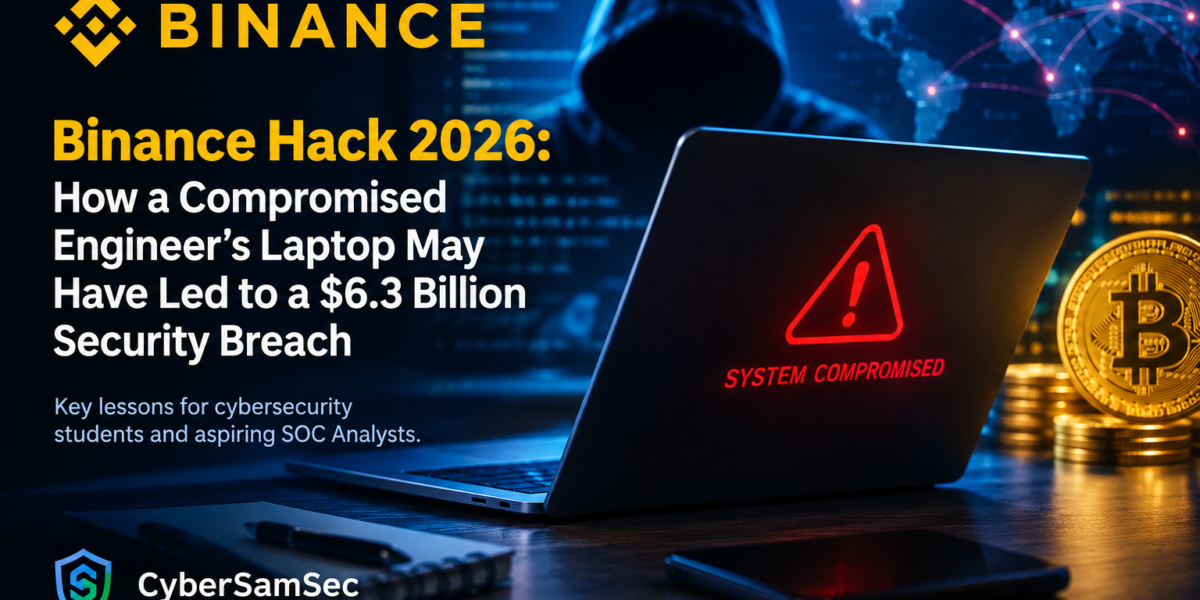
The cryptocurrency industry is facing another major cybersecurity incident following a security breach involving Binance, one of the world’s largest cryptocurrency exchanges.
On October 29, 2026, reports emerged that attackers had exploited Binance’s systems, leading to unauthorized cryptocurrency withdrawals. The estimated financial impact was placed at approximately $6.3 billion, making the incident one of the largest reported cryptocurrency security breaches.
But what makes this incident particularly interesting from a cybersecurity perspective is the possible entry point.
According to Binance’s initial investigation, the incident may have involved a compromised laptop belonging to a DevOps engineer. The attacker allegedly used access from the compromised device to reach a service container and submit unauthorized withdrawal transactions.
Binance also stated that it had found no evidence of a wallet private key leak.
This incident raises important questions about endpoint security, internal access controls and how organisations monitor privileged accounts.
What Happened in the Binance Hack?
Binance’s initial investigation points to a possible compromise of an employee’s laptop.
A DevOps engineer typically works with software development, deployment and infrastructure operations. Depending on their responsibilities and assigned permissions, such an employee may have access to sensitive internal systems.
In this incident, Binance indicated that the compromised laptop may have allowed the attacker to access a service container.
A service container is an isolated environment used to run applications and their dependencies. Containers are commonly used in modern cloud and software infrastructure.
The attacker reportedly used access to this environment to submit unauthorized withdrawal transactions.
The important distinction is that Binance has not reported evidence of wallet private keys being leaked. The investigation is still ongoing, and the complete technical attack path has not yet been publicly established.
How Much Was Affected?
Binance estimated the total impact of the incident at approximately $6.3 billion.
Following the discovery, the exchange worked with blockchain partners, law enforcement and intelligence organisations to trace and freeze affected assets.
In its October 30 announcement, Binance reported that approximately $3 billion had been frozen on-chain.
The company also announced several immediate security measures:
- Temporarily suspending deposits and withdrawals while security checks were conducted.
- Revoking the affected address authorisation.
- Working with blockchain intelligence partners to trace and recover funds.
- Engaging law enforcement agencies.
- Committing to cover the losses through its SAFU fund and company funds.
Binance also promised to publish a detailed technical post-mortem after the investigation is completed.
What Does This Incident Teach Us About Cybersecurity?
Beyond the financial impact, the Binance incident provides several important lessons for cybersecurity professionals and students.
1. Endpoint Security Is Critical
An endpoint is any device connected to an organisation’s network, including laptops, desktops and servers.
If an employee’s device becomes compromised, attackers may attempt to use it as an entry point into the organisation’s internal environment.
This is why businesses need endpoint security solutions capable of identifying suspicious activities.
Some important technologies include:
- Endpoint Detection and Response (EDR).
- Endpoint Protection Platforms (EPP).
- Antivirus and anti-malware solutions.
- Endpoint monitoring and logging.
For example, unusual PowerShell execution, suspicious process creation or unexpected connections to external servers could indicate malicious activity.
2. The Importance of Least Privilege
The Principle of Least Privilege means that users should only receive the permissions required to perform their assigned responsibilities.
An employee’s account should not automatically have access to every internal system simply because they work in the IT department.
Organisations can implement:
- Role-Based Access Control (RBAC).
- Multi-Factor Authentication (MFA).
- Privileged Access Management (PAM).
- Regular access reviews.
- Just-in-Time access.
These controls help limit the potential damage when an account or device is compromised.
3. Monitoring and Threat Detection Matter
Preventing every cyberattack is difficult. However, detecting suspicious activities early can reduce the potential damage.
Security teams should monitor activities such as:
- Unusual login attempts.
- Access to sensitive internal services.
- Unexpected privilege changes.
- Abnormal network connections.
- Unauthorised transaction requests.
This is where Security Information and Event Management (SIEM) solutions become important.
A SIEM platform collects and analyses logs from different systems, helping security teams identify suspicious patterns and investigate potential incidents.
4. Incident Response Can Limit the Damage
When an organisation discovers a security incident, its response can significantly influence the outcome.
Binance’s decision to temporarily suspend deposits and withdrawals demonstrates the importance of containment.
Incident response generally involves six stages:
- Preparation.
- Detection and analysis.
- Containment.
- Eradication.
- Recovery.
- Lessons learned.
These stages help organisations manage security incidents systematically rather than responding without a clear plan.
5. Internal Systems Need Protection Too
Cybersecurity is not only about protecting an organisation from external attackers.
Internal systems, employee accounts, cloud infrastructure and development environments also require strong security controls.
The Binance incident highlights why organisations should monitor internal access and avoid automatically trusting devices simply because they are connected to corporate infrastructure.
This is closely related to Zero Trust Architecture, which requires continuous verification of users, devices and access requests.
What Can Aspiring SOC Analysts Learn From This Incident?
For anyone working towards a career in Security Operations, this incident offers a useful opportunity to connect theoretical cybersecurity knowledge with real-world events.
A Tier 1 SOC Analyst may be responsible for monitoring alerts, reviewing logs, identifying suspicious activities and escalating incidents.
Imagine receiving an alert showing that an employee’s account accessed a sensitive internal service from an unusual location.
Your investigation might involve:
- Reviewing authentication logs.
- Checking the employee’s recent login activities.
- Examining endpoint security alerts.
- Identifying unusual processes.
- Reviewing network connections.
- Checking whether the account accessed resources outside its normal responsibilities.
You would then document your findings and escalate confirmed or high-risk activity according to your organisation’s incident response procedures.
Tools such as Microsoft Sentinel, Splunk and CrowdStrike Falcon can help security teams investigate different aspects of such incidents.
Another useful framework to study is MITRE ATT&CK, which helps security professionals understand and classify adversary tactics and techniques.
Final Thoughts
The Binance security incident is a reminder that even major technology companies face cybersecurity threats.
A compromised employee device, excessive access permissions or weaknesses in internal security controls can create opportunities for attackers.
However, it is important not to jump to conclusions before the full investigation is published. Binance’s initial findings provide a possible explanation, not yet a complete technical account of the attack.
As someone learning cybersecurity and working towards a SOC Analyst career, I see incidents like this as opportunities to understand how attacks happen and how security teams can detect, investigate and respond to them.
Cybersecurity is not just about knowing security tools or memorising concepts. It is also about developing the ability to recognise threats, investigate suspicious activities and understand how security controls work together.
Every security incident has lessons worth studying