One thing stood out during my CompTIA Security+ study today: resilience is not the same as redundancy.
At first, both sounded similar, but they solve different problems. Redundancy simply means having a backup. That backup does not always become available automatically. Resilience is broader. It is about making sure a business can continue operating even when something goes wrong.
Think about a supermarket. If one checkout closes, another cashier opens immediately. Customers keep moving. That is resilience in action.
Here are the concepts I learned that helped connect everything together.
Redundancy vs High Availability
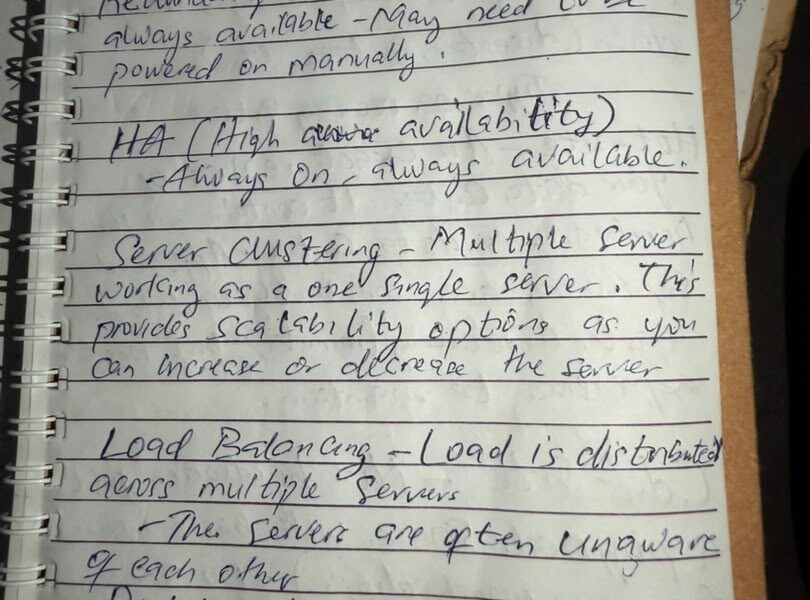
A common misconception is that redundant systems are always running.
That is not necessarily true.
A redundant server might exist as a backup, but someone may still need to power it on or activate it.
High Availability (HA), on the other hand, is designed to keep services available with little or no interruption. If one system fails, another takes over almost immediately.
A good everyday example is mobile networks. If one cell tower has issues, your phone may automatically connect to another nearby tower without you noticing.
Server Clustering
Server clustering means multiple servers work together as though they were one system.
Instead of relying on a single machine, several servers share the workload and provide backup if one fails.
For example, imagine a popular online store during Black Friday. Thousands of people visit at the same time. Rather than letting one server handle every customer, multiple servers work together so shoppers can continue browsing and paying without the website crashing.
Another advantage is scalability. As demand grows, additional servers can join the cluster.
Load Balancing
Load balancing works closely with clustering, but they are not identical.
A load balancer distributes incoming traffic across multiple servers.
Instead of every customer reaching Server A, requests are shared among Server A, Server B, and Server C.
Picture three bank tellers instead of one. Customers are directed to whichever teller becomes available first. The line moves faster because the workload is spread out.
Interestingly, the servers behind a load balancer do not always need to run identical operating systems. The load balancer focuses on directing traffic efficiently.
Site Resiliency
What happens if an entire building loses power?
That is where site resiliency becomes important.
Organizations often maintain another physical location where operations can continue if the primary site becomes unavailable because of fire, flooding, or other disasters.
For example, a company with its headquarters in Lagos might maintain another operational site in Abuja. If one location becomes unavailable, critical services can continue from the other site.
Understanding Recovery Sites
Not every backup location is built the same way.
Hot Site
A hot site is a fully equipped replica of the primary data center.
It already contains servers, applications, networking equipment, and updated data.
Recovery is extremely fast because everything is ready.
The trade-off is cost. Maintaining duplicate infrastructure is expensive.
Think of a television station that cannot afford to stop broadcasting. Every minute of downtime costs money, so a hot site makes sense.
Warm Site
A warm site sits between a hot and cold site.
Some hardware and software are already available, but everything is not fully synchronized.
Recovery usually takes hours rather than minutes.
It offers a practical balance between recovery speed and maintenance cost.
Cold Site
A cold site is simply a prepared location.
It may have electricity, networking, and physical space, but the servers and applications are not already installed.
Recovery can take days because equipment must be delivered and configured.
It is the cheapest option but also the slowest.
Geographic Dispersion
Another lesson I found interesting was geographic dispersion.
Keeping a backup site too close to the primary site defeats the purpose.
If both offices are in the same flood zone, one disaster could affect both locations.
A practical example is cloud storage. Many cloud providers replicate data across different regions so that a regional outage does not automatically affect every copy.
The downside is logistics. Employees may need to travel, equipment may need transportation, and coordination becomes more challenging.
Platform Diversity
Platform diversity means avoiding dependence on a single technology vendor.
Instead of running every system on the same platform, organizations mix different operating systems, applications, or hardware vendors.
Why?
If one vendor experiences a serious vulnerability, every system using that vendor is not automatically affected.
However, there is a trade-off.
More diversity means administrators have more technologies to manage, update, and secure.
Multi-Cloud Strategy
Many organizations now spread workloads across multiple cloud providers.
Instead of relying entirely on AWS, they might also use Microsoft Azure or Google Cloud.
If one provider experiences an outage affecting a specific service, another provider may continue supporting important workloads.
This reduces dependence on a single cloud environment.
COOP: When Technology Is Not Available
The final concept tied everything together.
Continuity of Operations Planning (COOP) asks an important question.
What happens if technology cannot be used at all?
Imagine a hospital experiencing a major systems outage.
Doctors still need patient information.
Nurses still need to record treatments.
The backup plan might involve printed forms, handwritten records, or phone calls until digital systems return.
These procedures should never be created during an emergency.
They must already be documented, practiced, and tested.
My Biggest Takeaway
Today’s lesson changed how I think about resilience.
It is not just about having backups.
It is about designing systems, locations, cloud services, and even manual processes so that people can continue working when unexpected problems happen.
The goal is simple.
Keep critical services running, recover quickly when disruptions occur, and always have a documented plan for when technology alone cannot save the day